IN THIS ARTICLE
Most creators do not stall because they stopped making good work. They stall because the business outgrew the tools. A brand emails about a paid partnership and it lands three rows under a shipping receipt. Someone comments "how much?" on a reel that is doing 200,000 views and the comment is gone by morning. A follower DMs asking whether you ship to their country, waits nine hours, and buys from someone else. None of that is a content problem. It is a routing problem, and it gets worse exactly as your reach gets better.
The honest description of a working creator inbox is that it is five systems wearing one coat: a sales pipeline, a support queue, a collaboration board, a billing reminder, and a newsletter reader, all stacked in the same list with no idea which is which. This piece is about collapsing that into one queue: every social channel, every Instagram automation, and the email address you actually do deals on, in a single place where an AI agent handles the repetitive share and hands you the ones that matter.
Where the money actually leaks
It helps to be specific about the losses, because they are rarely dramatic. Nothing breaks. You just quietly do not get paid.
- The buried collab. Brands email. Email is also where receipts, newsletters, platform notifications and your accountant live. A partnership offer with a real budget sits unopened for four days, and the brand moves on to someone who replied in four hours.
- The dead comment thread. A reel performs, the comments fill with buying questions, and by the time you look the post has fallen out of the algorithm's window. The reach was free. The conversion was not collected.
- The cold DM. Someone asks a sizing, shipping or availability question at 11pm. You answer at 9am. The intent was at 11pm.
- The invisible repeat. The same person comments on a reel, DMs you a week later and emails about a collab a month after that. To your tools those are three strangers. To your business it is one relationship you cannot see.
The pattern underneath all four
Every one of these is the same failure: the message arrived in a place that did not know what the message was worth. A partnership email and a newsletter look identical in an inbox. A buying comment and an emoji look identical in a notifications tab. Sorting that by hand is a job, and it is the job that grows fastest when your content works.
What "one inbox" has to mean to be worth anything
Plenty of tools promise a unified inbox and deliver a tabbed viewer: the same fragmentation, one login. A unified inbox is only useful if it changes what you have to do, and that requires three things that are easy to say and harder to build.
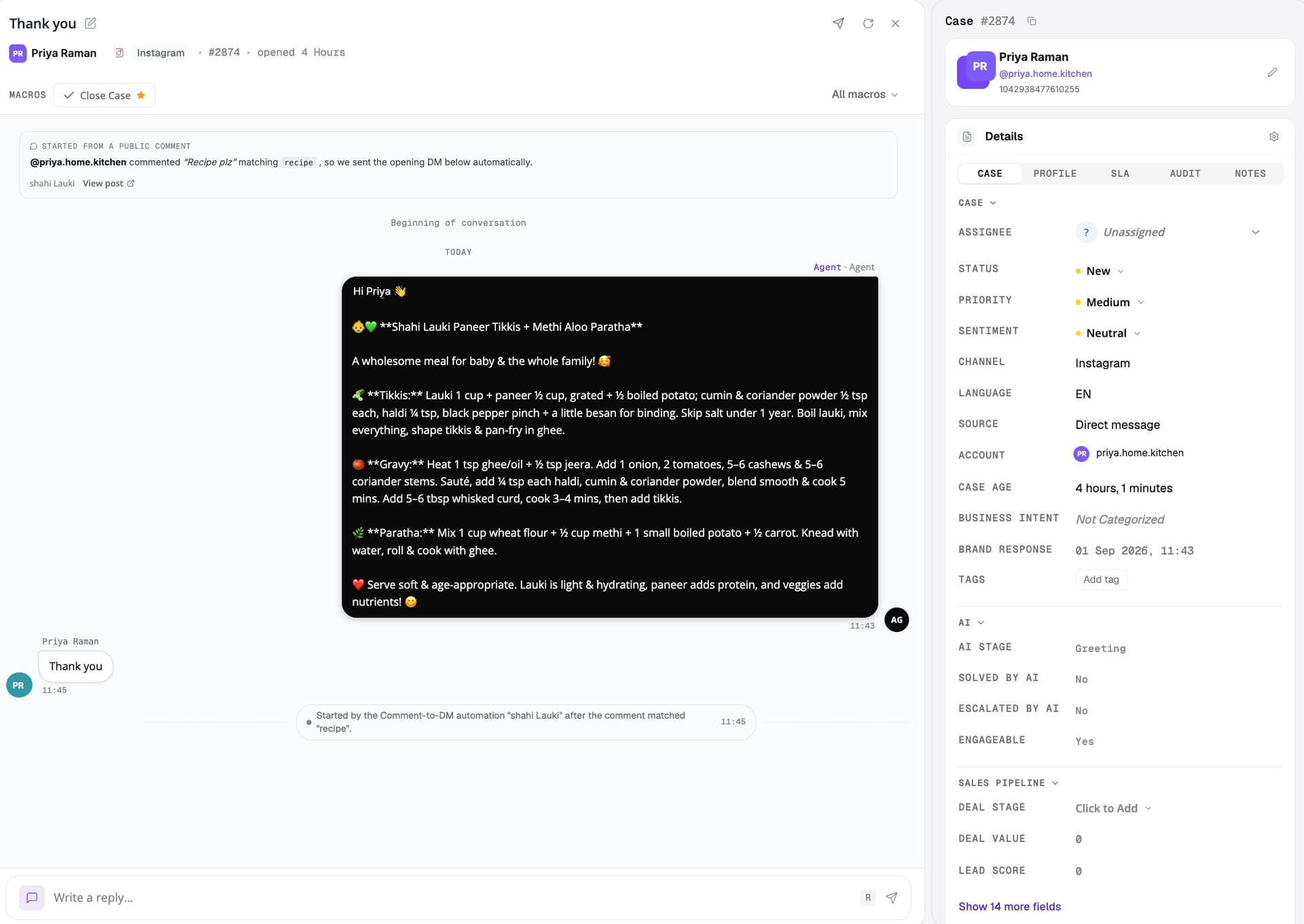
- 1One queue, not one window. Instagram DMs, comments, story replies and mentions, plus email, WhatsApp, Telegram and Facebook, arriving in a single ordered list with a status and an owner, the way a support desk works rather than the way a phone works.
- 2One person, not one message. If the same human commented in March, DMed in April and emailed in May, that is one record with one history, so you are never answering someone as though you have never met.
- 3Something that acts. A list you still have to work by hand is a prettier version of the same problem. The queue has to arrive already sorted, with the repetitive share already answered.
Why email belongs in a creator's social inbox
This is the part most social tools skip, and it is the part that pays. Social tools handle social. Email tools handle email. But a creator's revenue does not respect that split: the audience arrives on Instagram, and the money arrives by email. A brand discovers you through a reel and sends a partnership email. A viewer DMs a question and then emails an invoice query. Splitting those into two products means the highest-value message you receive all month is the one your social tool cannot see.
Put the two together and the collab email stops being a needle in a promotional haystack. It arrives in the same queue as the DMs, gets categorised by what it is rather than which app it came from, and can be flagged as needing you personally while the shipping questions around it are already handled. Delyt Social starts at $9/mo with Instagram automation and publishing. The inbox this article is about is Influencer Pro at $15/mo: the care console, plus email, WhatsApp, Telegram and Facebook in the same queue. That is the tier where this particular problem actually gets solved.
The layer that does the work: agents per channel
A single queue tells you what happened. Agents decide what happens next. In Delyt an agent is closer to a job description than a chatbot prompt: you say which channels it covers, what it may answer, what it must never touch, and exactly where a human has to decide. It answers from a knowledge base you load with your own content, so it repeats your facts rather than inventing new ones.
In practice most creators end up running two or three, and the split matters more than the number.
| Agent | Channels it covers | What it does | What it never does |
|---|---|---|---|
| Fan questions | Instagram DMs, comments, story replies | Sizing, shipping, availability, "where is this from", links and codes | Discuss money, promise a date, or speak for a brand partner |
| Buying signals | Instagram DMs, WhatsApp | Detects intent to buy, answers the objection, sends the link, captures the contact | Discount beyond the rules you set |
| Brand & collab | Recognises a partnership approach, acknowledges it, gathers budget and timing, opens a case for you | Accept, decline, or quote a rate |
The rule that makes this safe to run
The agent that talks to fans should not be the agent that talks to brands, and neither should be able to commit you to anything. In Delyt those boundaries are playbook steps enforced in code, not suggestions in a prompt, and every action is logged with the rule that triggered it. Nothing improvises on your reputation.
The compounding part, and the honest version of it
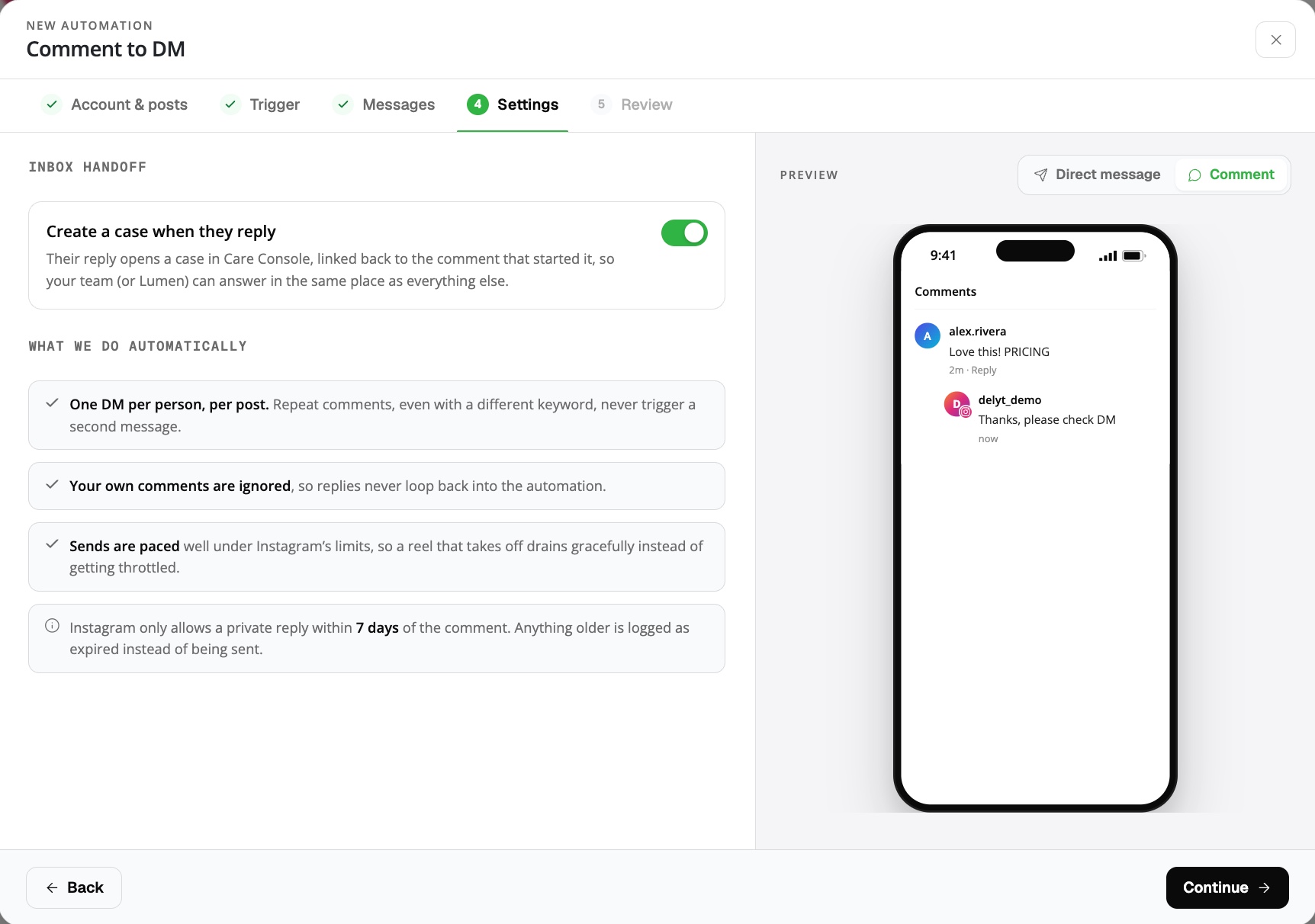
Here is the mechanism, stated plainly, because the growth claim only makes sense if the mechanism does. Comment-to-DM automation raises the comment count on a post, and comment volume is one of the signals that decides how far a reel travels. Further travel means more comments, which means more DMs, which means more conversations. That loop is real and it is why "comment a keyword" replaced "link in bio" as the default creator call to action.
What the loop needs to keep turning is answers. An automation that fires 2,000 DMs and then goes silent on the first follow-up question converts a spike into a shrug. The unified inbox and the agents are what stop the loop breaking at the second message: the reach compounds because the responses keep up with it, at 3am, on every channel, including the email where the partnership lands.
What we will not do is print a multiple. You will see "10x your account" on a lot of pages in this category and it is almost always someone else's screenshot. The number depends on your niche, your posting rate and your offer. The mechanism is the same for everyone: more comments raise reach, faster answers convert reach, and one queue is what makes fast answers survivable when the volume arrives.
Setting it up in an afternoon
- 1Connect Instagram with the official Meta login, then add the email address brands actually write to. Two OAuth flows, no developer.
- 2Load your knowledge: your FAQs, your products, shipping and returns, your rates if you want the agent to handle them. This is the single step that decides whether the answers sound like you.
- 3Arm your best-performing recent post with a keyword. One short, obvious word, said in the caption and the pinned comment.
- 4Write the handoff rules before you turn anything on. Brand deals, refunds, anything about money or anything emotional goes to you, with the full history attached.
- 5Watch the first fifty conversations. Correct the agent where it is thin, and the corrections become knowledge the next fifty use.
Every channel in one queue, from $9/mo
Delyt Social gives creators Instagram automation and publishing across five networks from $9/mo. Influencer Pro at $15/mo adds the care console where every reply becomes a case, AI agents in your brand voice, your knowledge base, and email, WhatsApp, Telegram and Facebook in the same queue.
See Delyt Social for creatorsWhat to measure once it is running
Delivery counts are a vanity metric; every tool can send DMs. The numbers that tell you whether the system is working are further down the funnel: how many people replied to the automated DM rather than just receiving it, how many conversations reached a link or a checkout, how many brand emails got a same-day acknowledgement, and how your median first response time looks across every channel rather than just the one you happened to check. If reply rate is climbing while your hours on the phone are flat, the system is doing its job.
FREQUENTLY ASKED QUESTIONS