IN THIS ARTICLE
Food is the category where "comment a keyword" was invented, and for a good reason: the thing people want is a document, the thing you want is a comment, and both sides are happy with the trade. Somebody watches thirty seconds of a bake, wants the quantities, and typing RECIPE is easier than finding a link in a bio. You get a comment, which is one of the signals that pushes the reel further, and they get the method. It is the cleanest exchange on the platform.
It stops being clean at scale. A reel that travels produces more "recipe please" comments than any human can answer, and food creators end up doing three evenings of copy-paste for a post that peaked on day one. Worse, the DMs that arrive after the recipe, the substitution questions, the "can I make this dairy free", the "how long does it keep", are the ones that build the relationship, and they are the ones that get abandoned first. This piece covers the setup that works, the keyword mistakes that quietly cost you half your replies, and what to do about the follow-up.
Why "link in bio" loses to "comment RECIPE"
- A comment is one tap where a bio link is four. Every step between wanting the recipe and having it loses people, and the bio route has the most steps.
- The comment itself buys reach. Comment volume is one of the signals that decides how far a reel travels, so the call to action grows the post while it collects the audience.
- A DM is a channel you keep. A bio click is a visit that ends. A DM thread is a person you can answer again next week, which is why creators who build on DMs compound faster than creators who build on link clicks.
- It fits how people watch. Nobody leaves a reel mid-scroll to open a browser. They will type six letters.
The keyword mistakes that cost the most
Almost every underperforming food automation fails for one of three reasons, and all three are fixable in about ten minutes.
- 1The keyword is too long or too clever. "GARLICBUTTERSALMON" or "SUNDAYBAKE2" produce misspellings, and a strict trigger does not match a misspelling. Use one short, obvious word. RECIPE works precisely because it is boring.
- 2The misspellings are not registered. Real comment sections contain "recipie", "recepie", "recipe?" and "RECIPE 🙏🙏". Add the variants as extra keywords. This single change recovers DMs you are currently not sending and never see, because a comment that does not match looks identical to a comment that does.
- 3The caption never actually asks. "Full recipe below" or a vague "let me know" gives the viewer nothing to type. Say the word, say it in the caption and again in a pinned comment, and say what they get: "Comment RECIPE and I will DM you the full method."
One keyword per recipe, not one keyword forever
If every post uses RECIPE you cannot tell which dish drove the DMs, and someone commenting RECIPE on an old reel gets whatever that automation currently points at. Use a per-post word where it is obvious (BROWNIE, RAGU, FOCACCIA) and keep RECIPE as the catch-all. You get cleaner numbers and viewers still have an obvious fallback.
What the first DM should contain
Deliver in message one. The temptation is to make people jump through something first, a follow request, a "reply YES to confirm", an email capture before the link. Every hoop loses people who were ready, and the ones you lose are disproportionately the casual viewers who would have become followers.
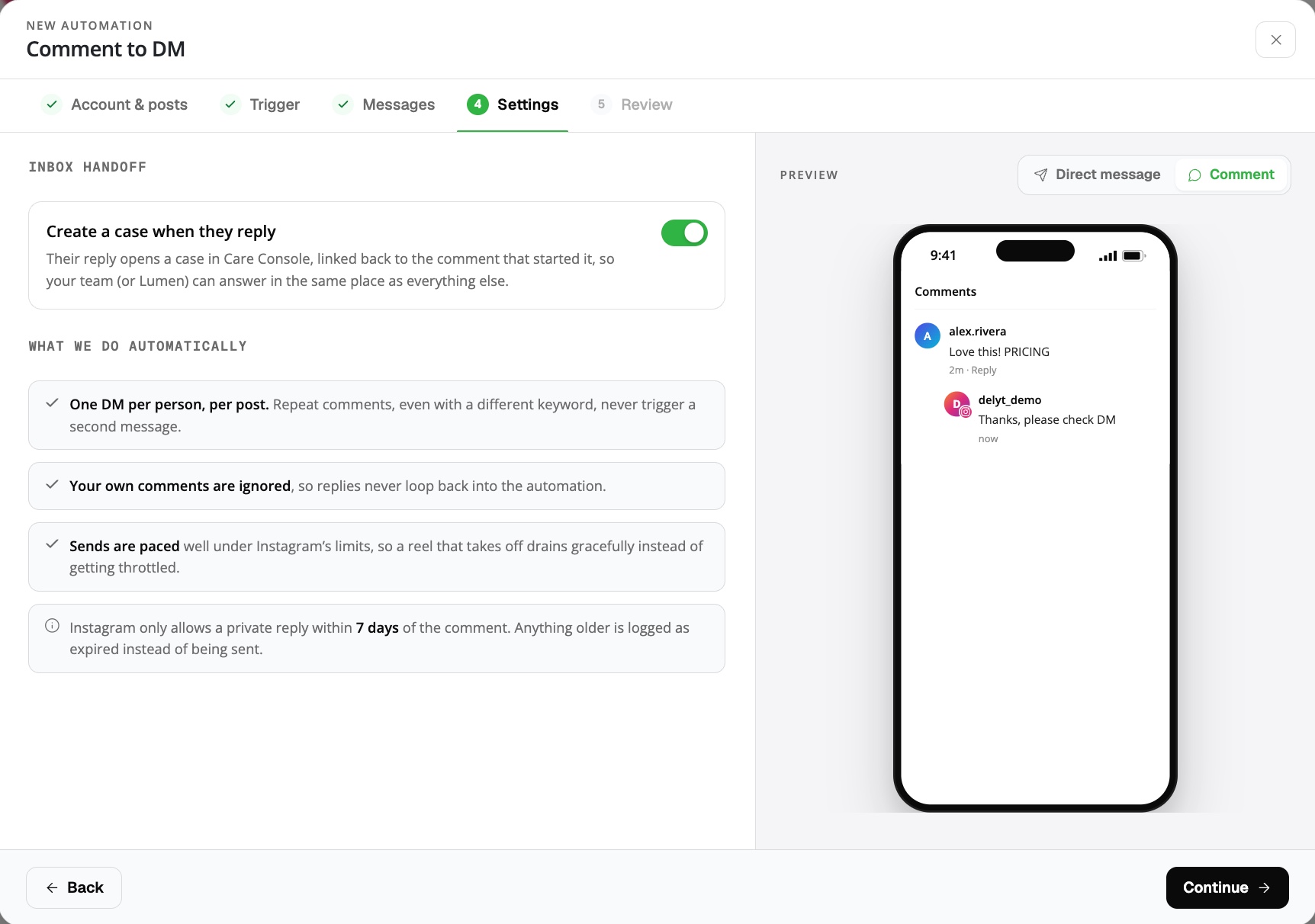
One thing worth knowing about the mechanics: Instagram opens the conversation properly once the person messages back, so a DM that invites a reply outperforms a bare link drop. That is a reason to end the first message with a real question rather than a hoop. "Here is the full method. Are you making it dairy free or as written?" is both a genuine question and the thing that opens the thread.
The part everyone underestimates: the second message
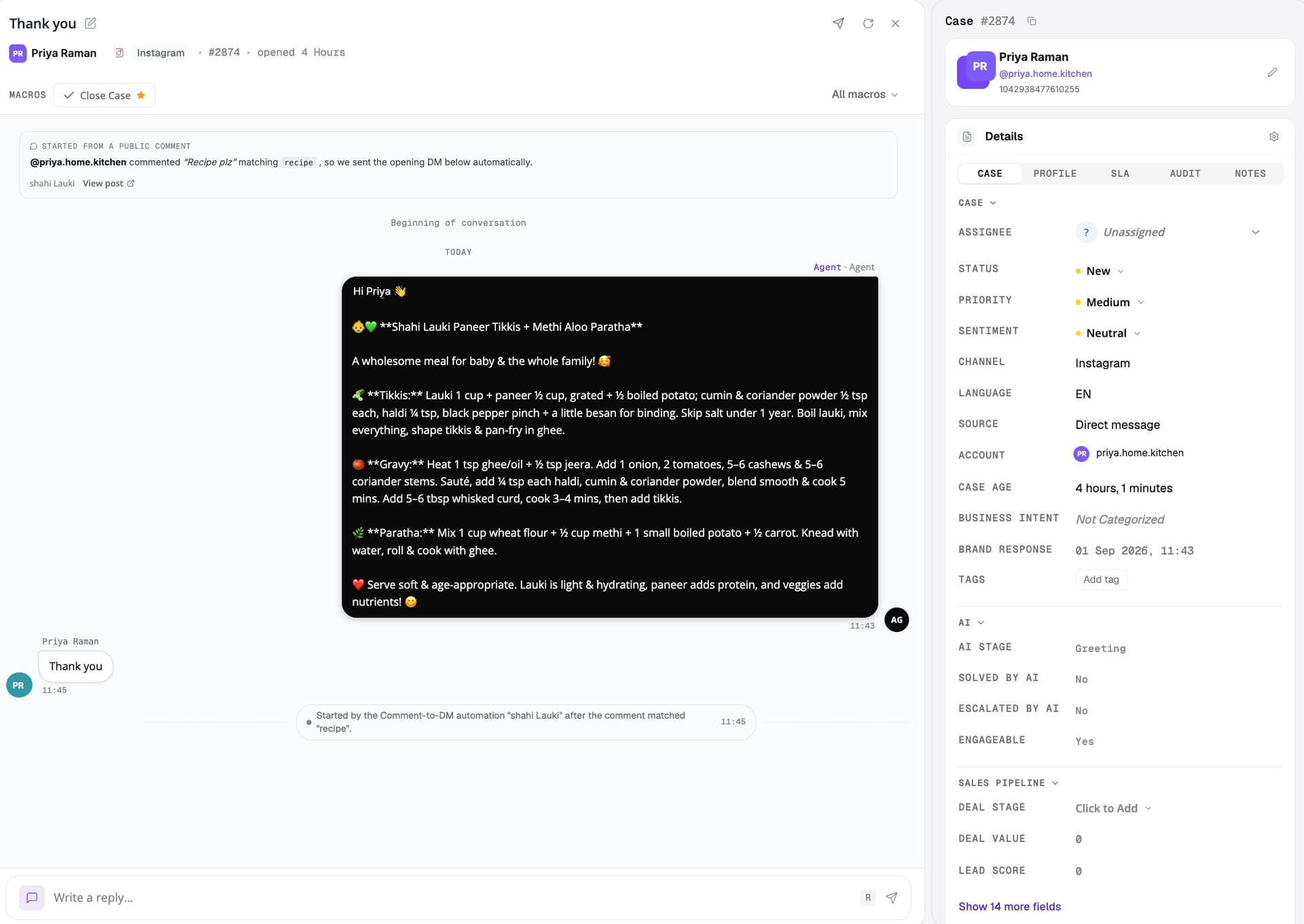
Sending the recipe is the easy half. What arrives next is a stream of genuinely useful questions: can I swap the buttermilk, is this freezable, what size tin, how far ahead can I make it, is there a gluten free version. Those are the messages that turn a viewer into somebody who comes back, and on a flow-based DM tool they hit a dead end, because nobody scripted a branch for "can I use oat milk".
The alternative is an agent grounded in your own material. You load your recipes, substitutions, storage notes and the answers you find yourself typing over and over, and it answers from that, in your voice, at 11pm on a Sunday when the person is actually standing in their kitchen. It is not writing new recipes; it is repeating yours. Anything it should not touch, brand approaches, anything about money, anything you have reserved, becomes a case in your inbox with the whole conversation attached.
| Message | Handled by | Why |
|---|---|---|
| "RECIPE" comment on the reel | The automation | Predictable trigger, fixed payload, needs to be instant |
| "Can I use oat milk?" | AI agent, from your knowledge | Your answer already exists, it just needs repeating at scale |
| "How long does it keep?" | AI agent, from your knowledge | Same answer every time, and wrong answers are a food safety problem |
| "We would love to sponsor a post" | You, as a case | Money, and a relationship worth handling personally |
Send the recipe while you are asleep
Comment-to-DM with keyword triggers and misspelling variants, story replies, unlimited automations, contacts and DMs, on a Meta-approved platform, from $9/mo. Add an AI agent that answers substitution and storage questions from your own recipes for $15/mo.
See Delyt Social for creatorsThe brand emails you are probably missing
Food is one of the most heavily courted creator categories, and the approaches arrive by email rather than DM: a kitchenware brand wanting a paid feature, a supermarket wanting a recipe series, a publisher asking about a book. They land in the same inbox as your receipts and newsletters, which is why a four-figure offer can sit unread for a week while you are busy answering substitution questions on Instagram.
Putting that email address in the same queue as the DMs is the fix, and it is a small change with an outsized effect: the partnership approach gets recognised for what it is and flagged as needing you, while the recipe questions around it are already handled.
What to measure
Comments and views are the easy numbers and the least useful ones. What tells you whether the system works is the funnel under each automation: comments matched to the keyword, DMs delivered, people who replied, links clicked. Reply rate is the one to watch, because it separates a recipe people wanted from a recipe people scrolled past.
Instagram will not give you this. Native Insights reports reach and engagement on the post, not the funnel underneath your automation, retains only ninety days of history and offers no raw export, so the comparison you actually want, whether BROWNIE outperformed RECIPE, whether Sunday evening beats Tuesday lunchtime, is not answerable from the app. We covered that gap in detail separately.
FREQUENTLY ASKED QUESTIONS